CrossFit Roselle Is More Than a Gym

Lynne Steiner • May 27, 2026

Last week, I stood in front of a room full of students at Frost Junior High.


I asked them to do a squat.

Then a push-up.


Then I asked them: if you trip and fall, how are you going to get up?


One kid raised his hand and said: "Is that why there are bars next to toilets?"

Yes. Exactly that.


We laughed. But I meant it.


The ability to squat is not a gym skill. It is a life skill. So is the ability to push yourself up off the floor. So is carrying a heavy box up a ladder, mowing your lawn without your back seizing up, or keeping up with your grandkids at the park.


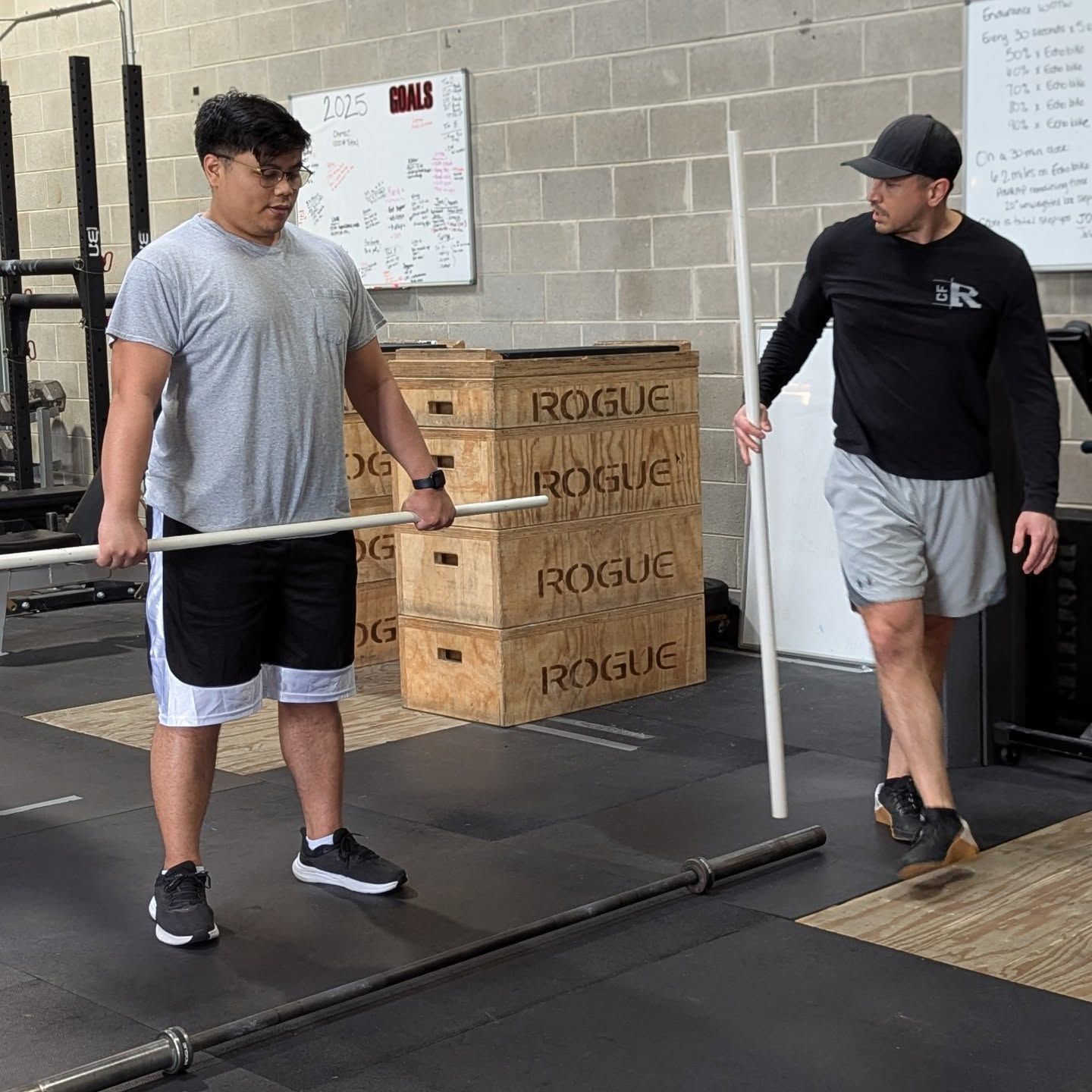
This is what we teach at CrossFit Roselle.

Not just how to lift more weight. How to live better.


What a small gym actually does for a community

Most people think of a gym as a place to work out.

We think of it differently.


CrossFit Roselle employs coaches who live in this neighborhood. We collect food for the Roselle Food Pantry. We sponsor the local swim team every year. We are in talks with the park district to support the pumpkin smash recycling event this fall. We speak at career day events even when public speaking makes us sweatier than a workout.


We show up because this community showed up for us.


When a member named Erin realized she could lift heavy boxes of Christmas decorations up to her husband in the attic without struggling, that was not just a fitness win. That was her life getting easier.


When Matt dropped 3.5 inches off his waist and stopped dreading mowing the lawn, that was not just a number. That was his Saturday back.


When Seth lost 20 pounds and found himself on the floor playing with his kids without thinking twice, that was not a gym story. That was a dad story.


These are the things we are actually here for.


Movement is not a hobby

At Frost Junior High, I asked the kids who had grandparents who couldn't travel alone anymore. A lot of hands went up.


I asked who knew someone who needed help getting up and down the stairs.

More hands.


Then I asked: what if regular exercise could have changed some of that?

The room got quieter.


Because the truth is, strength training and consistent movement are among the most powerful tools we have for staying independent as we age. Not just looking better. Not just losing weight. Actually being able to live the life you want, for as long as possible.


That’s what we teach our members.

That’s what I told those kids.


And it’s why, when I left that school after four groups and a long day of squats and push-ups and questions about toilet bars, I drove back home feeling more sure than ever that this work matters.


Small businesses are the backbone of communities

I also talked to those students about entrepreneurship.


About the long hours and the hard days and the loneliness that comes with building something from scratch.


But also about the moment a client sends you a text that makes you cry at your desk.


About the screenshot folder I keep on my phone full of wins people have shared with me over the years.


About the fact that this job, more than any other I have had, lets me change lives in real time.


Small businesses don’t just create jobs. 

They show up. 

They sponsor the swim team and fill the food pantry and stand in front of middle schoolers on a Wednesday and remind them that their bodies are capable of more than they think.


That is what we do here.


If you have been thinking about walking through our doors, we would love to meet you.


Every new member starts with a free no-sweat intro. 

No workout. 

No pressure. 

Just a conversation about your goals and what you want your body to be able to do.

Book your free intro here

More Posts

By Lynne Steiner July 6, 2026
You know the move. Event's at 5pm, so you skip breakfast. Skip lunch too, just to be safe. You're "saving up" like calories are airline miles. By the time you walk in, you're not just hungry. You're ravished. That gap between "saving calories" and "inhaling three plates before anyone's even cut the cake" isn't a willpower problem. It's basic biology doing exactly what it's built to do. Why Starving Yourself First Always Loses Here's the part nobody explains: hunger doesn't politely wait for your decision-making to catch up. It barges in, kicks your discipline out of the room, and orders for you. A few things happen when you show up running on fumes: Portion control disappears. Your brain isn't measuring servings anymore, it's running a hostile takeover. Everything looks like a yes. The potato salad you'd normally skip? Suddenly it's calling your name. You overshoot what you actually needed , often by a wide margin, because your body is trying to make up for hours of nothing. And here's the real cost. This isn't a one-time slip. If you do this at every birthday party, every BBQ, every family thing, you're training yourself into a boom-bust cycle. Restrict, then ransack the buffet. Restrict, then ransack again. Your body starts treating every social event like a famine followed by a feast, and that pattern is exhausting, both physically and mentally. The Fix Is Almost Insultingly Simple Eat a normal meal before you go. That's it. That's the secret. A plate with some protein and a little fiber an hour or two beforehand keeps your blood sugar steady and your brain in the driver's seat instead of your stomach. You walk in already satisfied, which means you get to actually *choose* what goes on your plate instead of grabbing whatever's closest out of sheer panic. Think of it like showing up to a negotiation. Would you rather walk in calm and clear-headed, or starving and desperate to take the first deal offered? Food works the same way. One Thing to Remember Showing up hungry isn't discipline. It's setting a trap for yourself and being shocked when it springs. Eat something solid before the next BBQ, vacation dinner, or family gathering. Protein, a little fiber, done. You'll walk in steady, in control, and free to actually enjoy the food instead of attacking it. The party was never the problem. Arriving starving was.
By Lynne Steiner July 3, 2026
Ashley competed in powerlifting. She knows what a loaded barbell feels like, what it means to step onto a platform, what it costs to train for a specific lift. She is not someone who needed to be convinced that strength matters. And yet, in her mid-forties, she found herself starting over. Not from scratch. Nobody with Ashley's history starts from scratch. But starting fresh, with new goals, in a new place, with a new definition of what being in the best shape of her life actually looks like. That kind of restart takes a different kind of courage than lifting a heavy bar. She joined CrossFit Roselle two months ago. Her boyfriend Joe, a long-time CFR member, had been talking about it for a while. "He has always had the BEST things to say about CFR," she says. Still, she was intimidated. She came anyway. What the On-Ramp Actually Does Before Ashley ever walked into a regular class, she went through CFR's on-ramp program. For someone with her background, you might assume that's unnecessary. It wasn't. "My on-ramp gave me a chance to get familiar with CFR, the culture, the coaching," she says. "It gave me confidence quickly in what I was doing, no matter where I was starting. I try to carry that into every class." This is exactly what on-ramp is designed to do. CrossFit is a specific language. The movements, the pacing, the culture, the way a coach cues you versus how a coach at a powerlifting gym cues you. None of that translates automatically, even for experienced athletes. The on-ramp is where you learn to speak it before you're expected to perform in it. Ashley walked into her first class already belonging there. That's the point. Twice a Week, on Purpose Ashley trains twice a week. For someone with her competitive background, that might sound conservative. It isn't. It's strategic. "For me to be consistent, I wanted to master that," she says. Consistency is the thing most people skip past in their excitement to do more. They come in four days a week for three weeks, then they burn out, or life intervenes, and then they're back to zero trying to rebuild momentum. Ashley decided she would rather own two days completely than chase four days inconsistently. It's working. In the past few weeks, she's added a third day. That's how sustainable frequency actually builds. Not by starting at your ceiling. What She's After Now Ashley's goals right now are specific: build lean muscle while continuing to lose fat. She is direct about the fact that those two things don't always cooperate with each other, and she is not in a rush. "I know these two things require different focuses," she says. "For now I am working on getting my workouts in, keeping my diet clean and getting the protein I need on a daily basis. Some days are better than others, but being consistent is the key." That's not a beginner speaking. That's someone who has been on a long road, who has tried faster approaches, and who has learned that slow and steady is not a consolation prize. It's the whole strategy. She's been working on her weight for most of her adult life. The version of Ashley who walked into CFR is down 225 pounds from her heaviest. Sixty of those came in the past year. Twelve since she started training here. None of that happened quickly. All of it required building habits that survived real life, not just good weeks. Her Tools, Her Terms Ashley is also using peptides as part of her approach, including a GLP-1 compound that helps her preserve muscle while losing fat. She came to it through her own research, and she is thoughtful about how she talks about it. "They are not a magic bullet," she says. "Like any other tool, they need to be accompanied by proper nutrition and weight training." That last sentence is worth reading twice. We are seeing more members come through our doors who are using GLP-1 medications and similar compounds to support their weight loss. And we think that's genuinely great. What those medications do really well is lower the barrier to change. What they do not do is build muscle, improve your cardiovascular capacity, or teach you how to move well. That part still requires showing up, putting in the work, and listening to the guidance of a coach. Ashley's approach is what this looks like when someone uses every tool available and uses them correctly. The medication supports the process. The training and nutrition build the body she actually wants. What She'd Tell You If you asked Ashley what the difference is between this time and other times she's tried to change her health, she'd probably tell you it's the consistency. And the community. "CFR is a place I get excited to go," she says. "Between the people and the workouts, it's become one of my favorite parts of the week." For someone who left CrossFit 10 years ago, came back through powerlifting, battled her weight for most of her life, and still showed up nervous to on-ramp anyway, that's not a small thing to say. It took her a decade to come back. She's not going anywhere. Ready to find out what the right start looks like for you? Our on-ramp program meets you exactly where you are. Reach out and let's talk.
By Lynne Steiner June 29, 2026
We've all played this game. Who can move a trunkful of groceries to the house in the fewest number of trips. Four bags stacked on each arm, milk swinging off two fingers, keys clenched in your teeth, foot kicking the screen door shut. Nobody films it. But that's the actual Olympics of your life. Now picture the gym mirror instead. Flexing under lighting built to flatter, comparing your reflection to a stranger online whose entire job is looking like that. One of those scenes builds the body you need. The other just builds resentment. The Mirror Lied to You First Aesthetic training chases a look: bigger arms, a flatter stomach, a number that feels like a report card. Nothing wrong with wanting to feel good in your clothes. But when "looking strong" becomes the whole goal, your body optimizes for things that do nothing for you on a Tuesday. Functional training chases capacity. It wants you to pick things up, carry them, and put them down without your lower back staging a protest. From the outside, both paths look the same. Same barbells, same sweat. The difference shows up later, when your body actually has to do something instead of just sit there looking good. What Your Body Is Actually Practicing Strength training isn't one thing. It's a set of patterns, and each one teaches your body a different real-life skill. Squat : getting off the floor, out of the car, up from a low couch Hinge : lifting laundry baskets and suitcases without your back arguing Carry : hauling groceries or a duffel bag while walking like a normal human Push and pull : opening a stuck door, rearranging furniture, lifting a suitcase to an overhead bin None of that requires a mirror. It just requires showing up, because eventually your life depends on it. That's what gets you on the dream trip without hesitating, or up the trail on a 5-mile hike without needing a rest every quarter mile. Train for Tuesday, Not for the Camera Stop asking "does this make me look strong" and start asking "does this make me more capable." Small shift in language, completely different gym. The deadlift isn't about hamstring shape. It's about handling the heavy thing without flinching. The farmer's carry isn't about shoulder definition. It's about loading a full trunk of groceries without a rest break. Aesthetic results show up anyway when you train this way. They're the receipt, not the goal. The body you build for real life will always outlast the one you built for a feed. So next time you're choosing between chasing the pump or chasing the strength, remember the groceries don't care how your arms look. They just want to make it up the stairs in one trip.
More Posts