He Didn't Run Out of Time. He Just Got Started.
Lynne Steiner • June 19, 2026

One of the things I love most about this gym is watching people surprise themselves. Not in the sexy, highlight-reel way. In the quiet, consistent, show-up-even-when-it's-hard way.


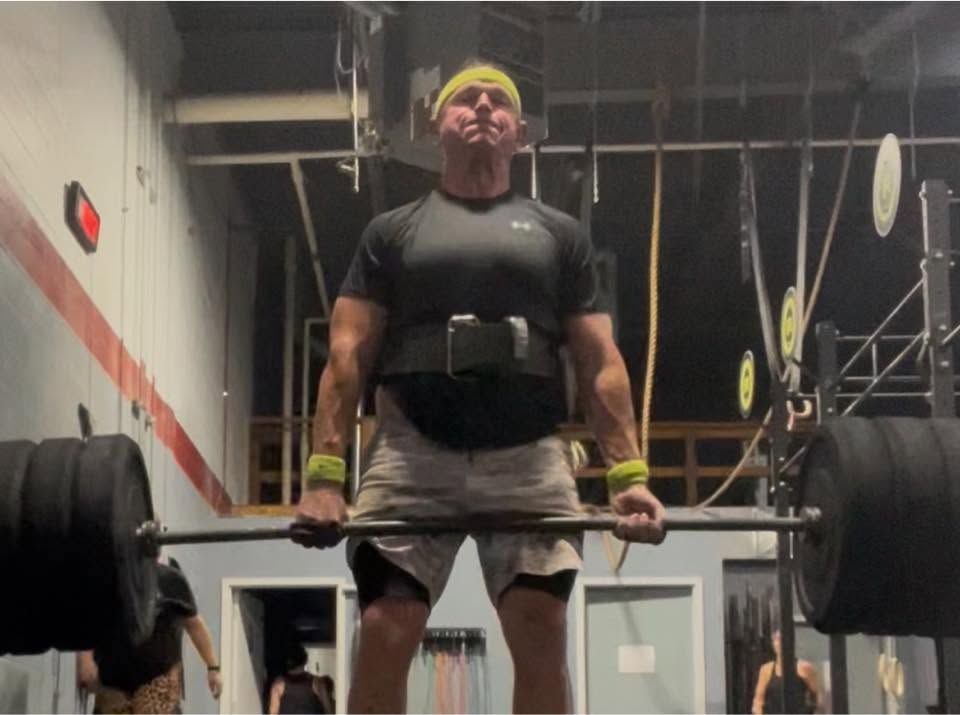
Mike Szymborski has been part of our CFR fam for a little over a year now. He trains 5 to 6 days a week. He is in his early 60s. He manages Type 1 diabetes. He has had a hip replacement, survived prostate cancer, and came back to the gym after a heart attack in March of 2025.


He also broke his pinky on a box jump during his first workout back after being cleared by his cardiologist. He finished the workout.


I asked Mike to share his story in his own words because he sets such a clear example of what is possible when you show up for yourself consistently regardless of age, injury, and medical conditions.


What follows is mostly him. I've added very little, because very little needed to be added.


Before CrossFit

"Back in my college days I lifted weights regularly. When I got married in 1992, I was in great shape, weighing 205 lbs. Then life happened. We had 3 kids by 1998. I spent my time working and raising a family."


In 2004, Mike was diagnosed with Type 1 diabetes and became insulin-dependent. The same year, he was becoming dependent on alcohol, too. The diabetes diagnosis, he says, is what made him stop drinking. He has been clean and sober since 2005.


"I ate what I wanted and took high doses of insulin to control blood sugar. My weight steadily climbed to about 290-300 lbs by 2015. When XXL polo shirts no longer fit comfortably and I had to buy size 44 pants, I knew something had to change."


He joined Weight Watchers and a local gym, lost 75 pounds over 9 months, and ran 2 half marathons. Then life happened again. The approach wasn't sustainable. His marriage of 26 years ended. By 2018, he had gained the weight back.


"I found myself alone, fat and miserable."


He Googled CrossFit. He found CrossFit Carol Stream. He dropped into a free class in December of 2018.


"I was hooked after the first class. I've been going 5 to 6 days a week ever since."


The Speed Bumps

Between 2018 and today, Mike's list of health challenges has continued to grow. Prostate cancer diagnosed in 2020, removed in 2021. As of January 2026, he’s 5 years cancer-free. Bone-on-bone arthritis in his right hip lead to a total hip replacement in October 2023. Then came a heart attack and stent in March 2025.


He also broke his foot doing a lateral burpee over bar. And the pinky. He mentions both almost as asides.


"In all honesty, I don't think about any of these past issues on a daily basis. I wake up each day and look forward to every challenge. The years are passing quickly. There is no reason to focus on negatives. Every day presents an opportunity to improve. That's what drives me."


When I asked him what a bad training day looks like, he said the question didn't really resonate with him.


"I don't think I've ever had a bad training day since I started CrossFit in 2018. CrossFit is the best part of every day for me, except days when I golf. Then it's a close second."


The Hip, the Open, and What Changed

For years, Mike couldn't squat below parallel. Not in a wall ball, a thruster, an air squat. The arthritis in his right hip made it impossible, and it meant he was scaling workouts that he wanted to do as prescribed.


The hip replacement changed that.


"My hip replacement and subsequent recovery allow me now to achieve parallel in these lifts. That's given me new-found confidence and the ability to record RX during workouts."


This year, Mike competed in the 2026 CrossFit Open and made the quarterfinals in his age group. He finished in the top 18%.


"That achievement was validation for my hard work. It created a greater sense of belonging to the CrossFit community at large and CrossFit Roselle specifically. I identify as a CrossFit athlete. It's what defines and differentiates me from my male friends in my age group."


What He Wants You to Know

Mike is active on social media. He posts his workouts for accountability and, more than that, to show other people what is possible. When someone in a Facebook group asks whether it's too late for them, or says their health history is too complicated, he shares a video of himself doing a handstand walk and lists what he has been through.


He listened to an audiobook that changed his focus to health span over life span.


"People in their 50s, 60s, and even 70s have already started to lose VO2 max and lean muscle. These losses will continue and the rate will even accelerate unless steps are taken to stop or slow the loss. Any level of movement is a positive step. CrossFit-style movements offer even more positive benefits as the movements address all 3 key metrics."


On the nutrition side, Mike's path to figuring out what actually works took some trial and error. He used Ozempic for 15 months and got his weight into a better range, but felt like something was still missing. After his heart attack, he went fully low-carb and keto. He credits that shift with reducing his A1C, reducing inflammation, stabilizing his weight, and giving him a general feeling of health he had never experienced over five decades of the standard American diet.


"Positive changes are very incremental and big changes come slowly. It's not a race to get to a certain point or fitness level. It's a journey. It's a process. If you don't like where you are, it's within your sole control to make changes which will bend your trajectory in the right direction."


What's Next

Mike turns 62 in September. His goal is to hit a new baseline weight by his birthday and hold it. He's eyeing the 2027 CrossFit Open and, eventually, the semifinals.


"I understand I might have to age into the 65+ age group for that to happen."


He says he's starting to feel some issues with his left hip. He suspects he may need a replacement within the next year or 2. He's not looking forward to it. He's also not going to let it go as long as he let the right one go.


He'll be in the gym tomorrow morning. Five or 6 days a week, like always.


A Note from Coach Lynne

I share Mike's story not because it's unique, but because it's honest. His progress was not linear. He didn't get here on a clean path. He got here by deciding, over and over, that the path was worth staying on.


If you're reading this and thinking your situation is too complicated, or that you've missed your window, I'd ask you to sit with Mike's answer to that question. He's been posting his own version of that answer on Facebook for years. Now it's here, too.


If this sounds like your story, or the story you want to write, we'd love to meet you.


Start with a free no-sweat intro at CrossFit Roselle. No experience required. No perfect health history required. Just show up, and we’ll take it from there. Click the "Book a Free Intro" box to get started.


More Posts
By Lynne Steiner June 22, 2026
You've been here before. The alarm goes off. You lie there running a quick internal audit: energy levels, mood, general enthusiasm for human movement. The results come back negative. You reset the alarm for tomorrow, when surely, surely, you'll feel more like it. Tomorrow has a terrible track record. Here's the uncomfortable truth nobody puts on a motivational poster: motivation is a feeling. Feelings are unreliable narrators. Building your fitness habit on motivation is like building a beachfront property. It looks fine until something actually tests it. The waiting room nobody escapes Waiting to feel motivated before starting is the most common trap in fitness. It feels responsible. Logical, even. Why force it when you're not in the right headspace? Because the right headspace doesn't arrive on its own. It gets created. Motivation follows action. It almost never precedes it. The science on this is clear, and so is every honest account from anyone who has stayed consistent for longer than three months. The "just start" principle works like this: Commit to two minutes. Just two. Put on the shoes. Drive to the gym. Grab a foam roller. Let momentum show up once you're already moving. The shoes are the hardest part. After that, your body usually decides to cooperate. The plan with no backup is a plan to quit Most people have one routine and zero contingencies. The routine is optimized for a perfect Tuesday when work ends on time, the kids are calm, and the stars have aligned favorably. Real life is not a perfect Tuesday. When the schedule collapses and the full workout isn't happening, there's nothing to fall back on. So people fall off entirely. The habit breaks. The restart ritual begins. Again. The fix is a "bad day" workout. Short, simple, and so easy to do that saying no to it would feel genuinely embarrassing: A 10-minute walk A single round of bodyweight squats, pushups, and a plank Ten minutes of stretching on the living room floor while something good plays in the background This isn't a consolation prize. It's a lifeline. The goal on a hard day isn't a great workout. It's keeping the habit alive. A small fire is infinitely easier to tend than a cold pit you have to relight from scratch. Stop waiting for perfect conditions Perfect conditions are fictional. They have always been fictional. The people who seem effortlessly consistent aren't operating under better circumstances. They built a system that runs without ideal weather. Tip: Right now, before you close this tab, write down your bad day workout. Three moves. Ten minutes. Something you would genuinely never say no to. Save it in your phone. The next time motivation goes dark, you'll have a flashlight ready. You don't need to feel ready. You just need to start. Readiness is what happens after.
By Lynne Steiner June 15, 2026
Picture this. It's the second week of June. The kids are home. You've got a vacation coming up, three cookouts on the calendar, and your carefully built morning routine has been run over by a school bus full of chaos. So you do what most people do. You quit. Not forever, you tell yourself. Just until things settle down. But "things" never settle down. Here's the truth nobody in the fitness world wants to admit: the all-or-nothing mindset is not a motivation problem. It's a math problem . And the math is broken. The Perfectionism Trap Is Costing You More Than You Think Most people operate on an invisible rule: if I can't do it right, I won't do it at all. Miss a week? Start over Monday. Schedule gets blown up? Abandon the plan entirely and wait for a clean slate. The problem is that clean slates are a myth, and summer makes it even more difficult. What the research actually tells us is that your body needs far less than you think to hold onto the fitness you've built. Maintaining muscle and cardiovascular capacity requires a fraction of the effort it took to build them. Two solid training sessions a week can preserve most of your hard-won gains. You are not starting over. You are in maintenance mode, and maintenance mode is a perfectly valid gear. The fitness industry sells you on progress because progress is exciting. But protection is the smarter play in June through August. Summer Obstacles Are Real. Stop Apologizing for Them. Disrupted sleep. Travel. Heat. Kids who need things approximately every four minutes. These are not excuses. These are legitimate variables that change what your body can recover from and what your schedule can absorb. The athletes who come out of summer in the best shape are not the ones who white-knuckled their way through a full training plan. They're the ones who pre-decided their summer minimum before the chaos arrived. They didn't wing it. They made a decision in advance: this is what I will always do, no matter what . Two days a week. Twenty minutes. Something instead of nothing. And then they protected that minimum like it was a bill that had to be paid. What "Good Enough" Actually Looks Like Two training days per week. Full body, efficient, non-negotiable. Bring the kids with you to the gym. Movement that fits the day you have , not the day you planned. A 15-minute walk beats a skipped workout every time. Zero guilt for the rest. The cookouts, the beach days, the late nights - those are the point of summer. The Takeaway Right now, before the calendar fills in around you, write down your summer minimum. Not your summer goal. Your summer floor. The thing you will do even when the week has gone completely sideways. Progress is for September. Summer is for not losing what you built. Good enough done consistently, beats perfect done never. Ready for more guidance? Click the Book a Free Intro button and see how we can help.
By Lynne Steiner June 8, 2026
Something exciting happens when you start exercising consistently. You have more energy. Your workouts feel stronger. You notice muscles you didn’t even realize you had. Then something unexpected happens. You're hungrier. The old voice in your head says, "Careful. If you're trying to get healthier, shouldn't you be eating less?" Not necessarily. In fact, one of the biggest mistakes active adults make is continuing to eat like they're still sedentary. Your Body Is Building Something When you exercise regularly, your body isn't just burning calories. It's rebuilding muscle. It's repairing tissue. It's adapting to become stronger, fitter, and more capable. Think of it like a home renovation. You can't add a second story to a house if the construction crew runs out of materials halfway through the project. Your body needs materials to do its work. That's where nutrition comes in. More Activity Means Different Needs Many people increase their workouts but never adjust their nutrition. They keep skipping breakfast. They avoid carbohydrates. They try to "be good" by eating as little as possible. Then they wonder why they're exhausted by Thursday. As activity levels increase, your body typically needs: More protein to support muscle recovery More carbohydrates to fuel workouts and daily life More water to support performance and recovery More overall calories than before It means fueling your body appropriately for the demands you're placing on it. The Warning Signs of Under-Fueling If your nutrition isn't keeping up with your activity level, your body will usually send a few signals: Constant fatigue Cravings that feel impossible to control Slower recovery between workouts Poor sleep Stalled progress in the gym Many people assume these are signs they need more discipline. Often, they're signs they need more fuel. Focus on Supporting Your Progress The goal isn't to eat as little as possible. The goal is to support the life you're building. To have the energy to crush a workout, chase your kids around the yard, work in the garden, and still have something left in the tank at the end of the day. Exercise creates the opportunity for change. Nutrition helps you take advantage of it. When your activity level goes up, your nutrition should evolve with it. Your body is doing more. Give it what it needs to succeed. If you've been exercising consistently but aren't seeing the results you'd hoped for, nutrition may be the missing piece. Schedule a free no-sweat intro here , and we'll help you create a plan that supports your goals, your lifestyle, and the stronger version of you you're working toward.
More Posts