Your Workout Has an Audience Now. Use It.

Lynne Steiner • July 13, 2026

Somewhere between the third and fourth round of a bodyweight couplet, when your kid asks if you're "almost done," is the moment you realize summer training has a new rule. You are not working out alone anymore. There is a small human nearby narrating your effort like a sports announcer and trying to mimic your movements.


Good. That is not a problem to solve. That is leverage.


The Audience Effect


Kids do not remember the lecture about eating vegetables. They remember the sight of a parent breathing hard, finishing something difficult, and not quitting halfway through. You can talk about discipline for years and it will land softer than ten minutes of them watching you actually finish a tough workout.


This is not a metaphor about parenting. It is closer to how muscle memory works. Kids build behavioral patterns the same way your body builds strength: through repeated exposure, not instruction. Every time they watch you train, that is a rep. The workout they see is doing more teaching than the one they don't.


What They're Actually Gaining


The modeling argument is the headline, but it's not the whole story. There's a shorter list of quieter benefits that don't get talked about enough.


  • Kids of active parents move more, without being told to. Not because you assigned them a chore chart of jumping jacks. Because activity became furniture in the house instead of an event on the calendar.
  • They learn what recovery from failure looks like in real time. Missing a rep, resetting, and trying again is a small, boring moment. It teaches more about resilience than any speech about "grit" ever will.
  • They get a body image model that isn't about appearance. A kid who watches a parent train for strength and capability, not for how they look afterward, absorbs a completely different relationship with their own body. That's not a small thing in a world selling them the opposite message before they're even ten.
  • They stop treating exercise as a punishment or a chore. If the only exposure a kid has to "working out" is a parent complaining about it, that's the lesson. If the exposure is a parent showing up, even irritated, even tired, and finishing anyway, that's a different lesson entirely.


Backyard Substitutions Members Are Actually Using


Not every workout survives contact with a toddler. Heavy barbell lifts need focus, and focus is the first casualty of a kid asking for a snack mid-set. But plenty of training translates well. If all else fails, change the workout location to the backyard for the day. This is what's been working around here this summer:


  • Air squats and push-ups swapped in for barbell work when the kids are circling like it's a small parade
  • A 12-minute AMRAP with movements that need zero setup so you can start the second there is a lull.
  • "Partner rounds," where the kid gets a lap or task between your sets, which somehow makes both of you finish faster


None of this is groundbreaking. That is the point. The workout does not need to be clever. It needs to happen.


The One Thing to Avoid


Here's where people trip themselves up. September arrives, the schedule snaps back into shape, and the guilt shows up right behind it. Suddenly it's five days a week, a diet overhaul, and a training plan aggressive enough to make up for a summer that wasn't lost in the first place.


Don't do that to yourself. A summer of consistent, imperfect training is not a debt you owe your fall self. It's the deposit.


Bring Them In


If the backyard version has gotten stale, bring the kids to the gym. Let them watch it happen somewhere other than your living room for once. Ask a coach for help figuring out the best way to make it happen.


The workout was never really about the workout. It's about what gets modeled while nobody's grading the performance.


More Posts
By Lynne Steiner August 26, 2026
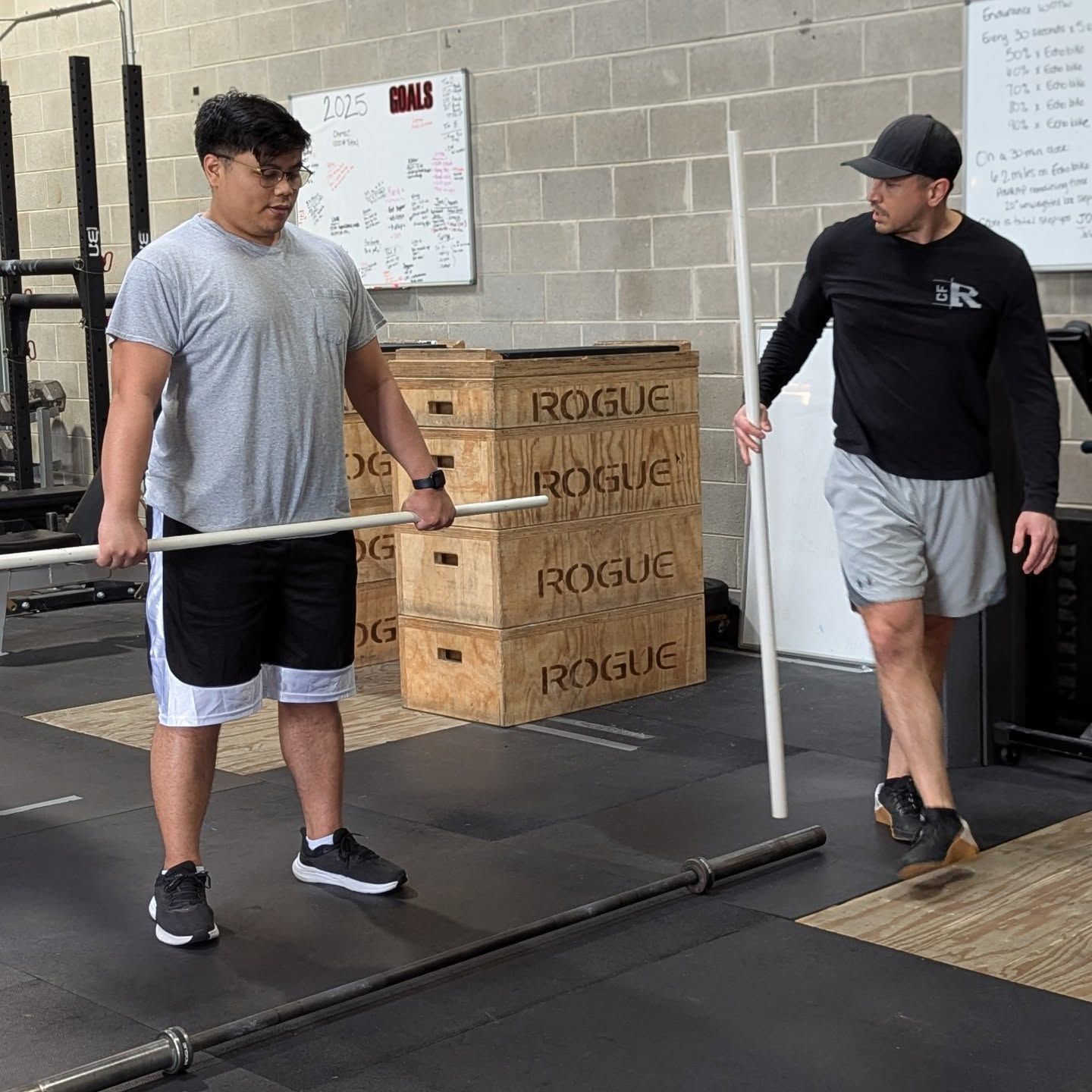
What does it take to stick with something for 15 years? Not motivation. Motivation runs out. It takes something else, something closer to a habit that turns into a life. Aaron sent his first email about CrossFit Roselle on July 1, 2011. He still has it. Before that, he'd tried the Bartlett Park District gym and a couple months at a different CrossFit gym. Nothing stuck until a friend told him to come check out CFR. His first Saturday WOD, he ran into a guy he went to high school with. "I've always challenged myself in different ways, from triathlons to Tough Mudders and Spartan races," Aaron said. "The park district gym just wasn't doing it for me. I needed something different. I needed a community." That word, community, comes up again and again when Aaron talks about why he's still here. The Numbers Don't Even Tell the Whole Story Our tracking software puts Aaron's class count at 1,469 over the past 11-ish years. But his membership goes back further than the software does. Fifteen years of showing up, habitually. He's not chasing a leaderboard spot. He's not hunting a PR every week. Ask him what keeps him coming back thousands of times and he doesn't talk about specific lifts at all. "I'm always pushing to make it a minimum of three to four days a week," he said, "and I enjoy hitting up a local CrossFit affiliate whenever I'm traveling." Consistency, not numbers on the whiteboard. Showing up on the ordinary weeks, not just the ones where something big is on the line. Still Chasing Something Fifteen years in, Aaron still has a list of goals he’s after. When asked what’s changed since year one, he said - laughing - "getting older!" Then he explained double-unders are still torturing him, and Kelsey won't let him forget that he needs to keep chasing that goal. That's the part people miss about long-term members. It's not that they've mastered everything and now just show up out of habit. Aaron still has skills to chase, weights to move, movements to clean up, and workouts he looks forward to every year: Murph, the 12 Days of Christmas workout, and the CrossFit Open specifically. He's watched CFR's approach to the Open grow into something bigger each year and calls the energy around it “electric.” (We agree. 🤗) A New Kind of Freedom For years, Aaron's training happened around full-time dad duty. His daughters are off at school now (and graduating in December, “following dear old Dad with degrees in Accounting!”), and that's changed things. "It's nice having the freedom to make fitness more consistently about me again," he said. He's still trying to recruit his daughter Jessica away from a globo gym but so far, “she's not convinced CrossFit isn't trying to kill her.” But the bigger shift for Aaron hasn't been about training harder now that he has more time. It's been about showing up for other people. He's known for driving long distances to cheer at teammates' competitions. Earlier this year, that meant helping record a teammate's lifts at a meet out in St. Charles. "I just love the effort put out, and I do my best to absorb some of that same energy," Aaron said. "I always love being able to help, even with the small things." That same instinct shows up on Sunday mornings, too. Aaron's part of the regular Sunday open gym crew, the ones who show up to work on weaknesses, do some lifting, or catch up on something they missed earlier in the week. If you've never joined them, he'd tell you to pop in. The more, the merrier. What He'd Tell Someone New If a brand-new member asked Aaron why they should stick around past the first three months, his answer is simple. "This place grows on you. You develop the relationships, and you want to show up to work out, sweat, and grind right along with your new friends." He's watched it happen in real time with newer members finding their footing and building friendships that keep them coming back. Proud, Not Finished Fifteen years is a long time to keep choosing the same gym. Ask Aaron what his younger self would think if he could see him now, and he doesn't talk about gold stars or records. "I think 15-years-ago me would be proud that I'm still here. Not because I've mastered everything, I definitely haven't, but because I kept coming back, kept challenging myself, and kept taking care of my body. At 57, being able to walk into CFR, train hard, and still have things I want to improve is something I'm genuinely proud of." A quick note to explain the photo choice, because this is not the type of picture I typically include for a CFR member story. But if you flip through 15 years of CFR photos looking for Aaron, you'll notice something... He's rarely the one front and center. He's in the background of someone's PR, grinning in a group shot, holding a phone up to record someone else's lift. Some people show up for the spotlight. Aaron shows up for everyone else's. That's Aaron's story. Fifteen years, thousands of classes, and he's still not done.
By Lynne Steiner August 24, 2026
It's 9:14pm. You're standing in your kitchen in workout clothes you put on three hours ago with the best of intentions. The dishwasher needs unloading. Your phone has four unread texts. And somewhere in the back of your brain, a tiny exhausted voice is trying to decide between a run, some pushups, or just... not. You don't do the run. You don't do the pushups. You eat a granola bar standing over the sink and call it a day. Here's the thing nobody tells you: that wasn't a willpower problem. That was a decision problem, and decisions are the most expensive thing you own. Your Brain Has a Daily Spending Limit Think of your decision-making energy like a phone battery. Every choice you make chips away at the charge, whether it's picking an outfit, answering a work email, or negotiating with a toddler about why socks are mandatory. By the time you get home, you're not at 100 percent. You're barely hanging on at 12 percent with low-power mode kicking in. Now ask that same depleted brain to design a workout from scratch. What muscle groups did I hit yesterday? How many sets? Is this too much or not enough? Should I even be doing this? That's not a workout. That's a pop quiz you didn't study for, and your brain will do what any reasonable brain does with a pop quiz: avoid it. The Real Cost of "I'll Figure It Out" Choice paralysis wins by default. When there's no plan, the path of least resistance is always the couch. "Figuring it out" quietly becomes "doing nothing." Not because you're lazy, but because deciding is exhausting and your tank is already empty. The people who stay consistent aren't more disciplined. They've simply removed the decision from the equation entirely. This is the piece most people miss. It was never about wanting it enough. It's about how much mental fuel is left in the tank once you've survived your actual day. What a Coach Actually Does A good coach isn't a drill sergeant standing over you with a whistle. A coach is a decision-eliminator. They've already answered the questions that would otherwise eat your last 12 percent of battery: What should today's workout be How hard should it be What comes next week, and the week after that All you have to bring is your body. The thinking has already been done for you, which means the only decision left is the easiest one there is: show up. The Takeaway If you find yourself standing in your kitchen most nights negotiating with yourself instead of moving, that's not a motivation problem. That's a signal. Busy life doesn't call for more willpower. It calls for fewer decisions. This week's tip: the next time you catch yourself deciding whether to work out instead of just doing it, notice that. That hesitation is exactly the gap coaching is built to close. If you notice it becoming a trend, click the red Book a Free Intro button and find out more about how we can help.
By Lynne Steiner August 17, 2026
The Sentence I've Heard a Thousand Times Every coach has a sentence that haunts them. Mine isn't dramatic. It's not "I can't do this" or "I'm too out of shape." It's quieter, and somehow worse: "I'll come in once things settle down." I hear it in September, right after the first bell rings. I hear it again in January, dressed up as a New Year's resolution deferred. By March it's back, wearing a spring cleaning costume. Same person. Same sentence. Different calendar page. Here's the thing nobody tells you about "settled down": it's not a season. It's a mirage. You chase it, the horizon moves, and you spend years walking toward a place that was never going to arrive. What Waiting Actually Costs You The missed reps add up, but that's not the real damage. A few skipped weeks won't wreck your fitness. What wrecks people is quieter and slower. Every excuse you keep becomes a belief you carry. Say "I'm not ready" enough times and your brain stops treating it as an excuse. It starts treating it as a fact about who you are. The bar for "ready" keeps climbing. The version of you that almost started in September needs a cleaner schedule than the version that almost started in July. Wait long enough and "ready" becomes a fortress with no door. I've watched members do this dance for years. Not because they lack discipline. Because nobody ever told them the dance had no finish line. The Fix Isn't a Calmer Life. It's a Smaller Ask. You don't need your whole life in order to walk through a gym door. You need one rep, on one Tuesday, in the middle of whatever mess is currently calling itself your schedule. Stop waiting for calm water. Learn to swim in the current you actually have. The people who show up aren't the ones with fewer obstacles. They're the ones who finally noticed the obstacle wasn't going anywhere, and came in anyway. If you've said this sentence more than once, that's not a scheduling problem. That's the signal. Come in messy. Come in tired. Come in on a Tuesday that looks nothing like "settled." That's what showing up actually looks like, for everyone, every time.
More Posts