Why Reflection Makes You Fitter: Your Body Remembers Everything (Even When You Don’t)
Lynne Steiner • December 1, 2025
You know what’s wild?
Your body keeps receipts.
Every squat you powered through, every Monday you almost skipped, every workout where you wandered in half-asleep and still managed a PR—your body remembers it all. Meanwhile, your brain? It tends to file the whole year of training under “Could’ve done more.”
But here’s the truth: reflecting on your year of fitness is one of the most powerful performance tools you have.
Not because it’s sentimental.
Not because it’s New Year’s-y.
But because reflection sharpens your training with the precision of a laser pointer...and without it, you’re basically throwing darts in the dark.
Today, we’re pulling the curtain back on the science, the psychology, and the sheer magic of looking back so you can move forward with purpose.
👉By the way, this reflection is built in to membership at CFR. When you join our fam, we schedule check-ins at the 30, 60, and 90-day marks, and we schedule goal reviews every 90 days after that (sooner if needed!). We support you and your goals and provide the coaching and accountability that keeps people from making progress. We got you.
Your Body Knows the Story, Do You?
Think about the last 12 months like a movie montage.
Quick flashes of chalky hands.
Cold mornings when your steering wheel doubled as a hand heater.
Work days that drained you like a phone on 1% battery but you showed up anyway.
Each moment is a data point—and data, used well, becomes direction.
But most athletes never look back. They set goals on January 1st, promptly forget them by February 8th, and then wonder why the next year feels exactly like the last one, only spicier and with more burpees.
Here’s the trap:
If you don’t look at the story your year tells, you repeat the same chapter again.
And again.
And again.
Like a fitness Groundhog Day.
Reflection is how you break the loop and step into a new chapter with intention.
Pain Point #1: Training Without Reflection Keeps You Stuck
Let’s be brutally honest:
Most people train on vibes.
They come when they feel good.
They push hard when the energy is right.
They coast when life kicks them in the shins.
And listen, this is human. But it also means:
You can’t improve what you don’t track.
When you avoid reflection:
- You miss patterns in your attendance
- You miss signs that your recovery is screaming for help
- You miss opportunities to adjust your plan before burnout hits
- You repeat training mistakes out of sheer habit
Athletes often think they need more intensity, when the truth is they need more insight.
Here are the reflection questions most people never ask themselves, but absolutely should:
- What months was I the most consistent? (If you're at CFR, our software has tools to show you!)
- What derailed me when I lost momentum?
- What movements felt better by the end of the year?
- What movements are still the fitness equivalent of stepping on a Lego?
- How did my recovery habits help—or sabotage—my performance?
Reflection isn’t judgment.
Reflection is illumination.
It’s shining a flashlight on a trail you didn’t realize you’ve been blazing all year long.
Pain Point #2: You Only Set Goals Once a Year
Annual goal-setting is cute.
It’s also deeply flawed.
Think of your training like driving a car.
Setting goals once a year is like adjusting your mirrors in January and never touching them again...even if someone bumps into them in March.
You need micro-adjustments. Frequently.
Most athletes make one of two mistakes:
- They set goals once a year and never revisit them
- They set goals so vague that even the GPS can’t find a route
Here’s why that fails:
- There’s no feedback loop
- No checkpoints
- No honest evaluation of what’s working
- No course correction when life gets spicy
But when you reflect regularly, even once a month, something magical happens:
You stop drifting and start driving.
Reflection gives you:
- Awareness of what’s actually happening
- Clarity about what needs to change
- Permission to pivot without guilt
- The ability to celebrate progress you would’ve forgotten
Let me put it this way:
Your body evolves week to week.
Your life changes month to month.
Your goals should breathe with you, not sit frozen in time like a museum exhibit nobody visits.
Reflection as a Performance Tool (Not a Feel-Good Exercise)
Reflection in fitness is often treated like journaling by candlelight—soft, cozy, slow.
But in reality?
Reflection is a performance mechanism.
It’s how high-level athletes, coaches, and sports scientists identify plateaus, optimize stress/load, and build efficient training cycles.
It’s not therapy.
It’s strategy.
When you look back at your year of fitness, you’re mining for gold:
- Where did I get the best strength gains?
- When did I feel burned out?
- What habits supported my progress?
- What friction points kept slowing me down?
- How did my sleep, protein, hydration, or stress impact my training?
This isn’t self-help.
This is self-awareness, which happens to be one of the most potent athletic skills you can develop.
A reflective athlete is a dangerous athlete—in the best way.
They train with direction, not desperation.
They know when to push, when to pull back, and when to adjust the plan.
But How Do You Actually Reflect on a Year of Training?
Great question.
Let’s keep it simple so your brain doesn’t short-circuit like a malfunctioning toaster.
Choose one area to evaluate:
Training Frequency
How often did I walk through the doors? When was I most consistent?
Performance Trends
What movements improved? Which ones stalled?
Lifestyle Factors
Did my sleep, nutrition, or stress impact my performance? (Spoiler: yes.)
Injury or Pain Patterns
What kept popping up like a raccoon in a dumpster?
Pick one. Make notes. Connect dots.
This is the “aha moment” factory.
This is where progress stops being accidental.
Because once you understand what happened this year, you can choose what happens next year.
Conclusion: Pick One Metric and Let Next Year Begin Today
If you take away nothing else from this entire post, let it be this:
Reflection makes you fitter because it makes you intentional.
Not busier.
Not more intense.
Just smarter.
Here’s your simple action step:
Pick ONE metric to track each week for the next month.
Choose from:
- Hours slept
- Grams of protein
- Training sessions attended
- Recovery quality
- Average daily steps
One metric.
Four weeks.
Zero overthinking.
Because once you start paying attention, you stop training on vibes and start training on purpose.
Your year taught you something...probably more than you think.
Now it’s time to use that wisdom to move forward with clarity, confidence, and a plan that aligns with the athlete you’re becoming.
And trust me:
When reflection becomes part of your training, progress stops feeling random and starts feeling inevitable.
More Posts
Why Your Fresh Start Doesn’t Need a Calendar
Your body runs on a clock. Every fall, someone sneaks in and starts nudging the hands. You feel it by mid-October. The 3 pm slump moves in like a houseguest who never leaves. Dinner turns into second dinner. Your gym bag sits by the door, staring at you like a disappointed golden retriever. On November 1, the clocks fall back and the sun starts clocking out around 4:30. That isn’t a willpower problem. It’s a rhythm problem. And rhythm problems have fixes. Why shorter days hit so hard Your internal clock takes its orders from light. Bright morning light tells your brain the day has started, which sets the timer for energy now and sleepiness later. Steal that light and the timer goes fuzzy. You wake up groggy, fade by afternoon, then lie in bed somehow tired and wired at the same time. Meanwhile, the evening daylight that used to whistle you to the gym is gone before you leave work. No cue, no habit. Catch the morning light Step outside within 30 minutes of waking. Ten to fifteen minutes does the job. Clouds still count. A gray sky is far brighter than your kitchen lights. Stack it. Drink your coffee on the porch, walk the dog, or park at the far end of the lot. Train at the same time every day Daylight used to tell you when to train. Now the clock has to. Treat your workout like a dentist appointment. You don’t cancel those because it’s dark out. Lay out your gear the night before. Future you is a negotiator. Take away the bargaining chips. Cold morning? Add a few minutes to your warm-up. Stiff joints are like a frozen car engine. Give them time to turn over. Lead dinner with protein Long, dark evenings are snack territory. Around 8 pm, the pantry starts whispering your name. Build dinner around a solid portion of protein. It keeps you full longer than a plate that’s mostly carbs. Close the kitchen after dinner. Brush your teeth early if you need a hard stop. Toothpaste and cookies make a terrible duet. Start with one You don’t need all three by Monday. Pick the anchor that feels easiest, run with it for a week, then add the next. Shorter days change your rhythm. They don’t change your capabilities.
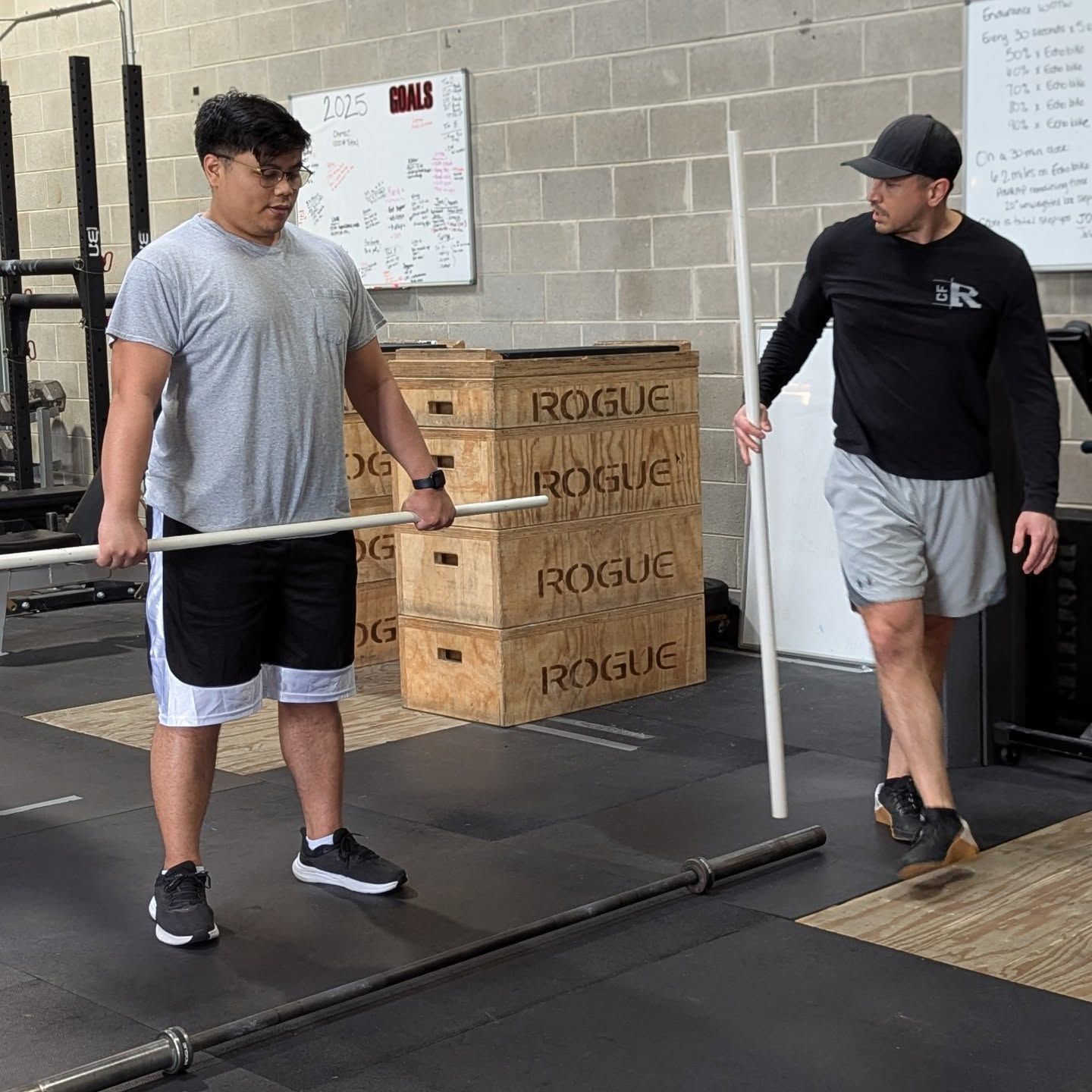
Would you teach a brand new driver on the highway at rush hour? Probably not. You'd start in an empty parking lot. Somewhere quiet, where mistakes cost nothing and someone sits right beside you, pointing out what to adjust. That's the idea behind our on-ramp program. It's been a while since we talked about it here. And if you joined us for a free community workout recently, you've seen what a CrossFit Roselle class looks like. This is what happens before you step into one. What on-ramp actually is On-ramp is five personal training sessions. Just you and a CFR coach. We start with the foundations: squatting, hinging, pressing, pulling, and moving your own body well. Then we build, session by session, all the way up to the Olympic lifts. Yes, the snatch and the clean and jerk. Along the way, you learn the language of CrossFit. What the workout names mean. How to pace yourself. How to scale a movement so it fits you today. What your coach means when they say "chest up" or "drive through your heels." By your first class, none of it feels foreign. You walk in already knowing how to train here. Why one-on-one matters A group class is a great place to train. It's not the best place to learn. Walking into a room full of strangers is intimidating for almost everyone. In on-ramp, the only person watching is your coach. You can ask the question you think is silly. You can try a movement six times before it clicks. Nobody is waiting on you. In a class, a coach is watching a dozen people at once. They'll catch the big stuff. One-on-one, your coach sees everything. The knee that drifts in. The heels that lift. The bar that swings away from your body. They fix it on that rep, not three weeks from now. And the plan bends around you. Schedule limitations? Tight hips? An old shoulder injury? A movement that just isn't clicking today? Your coach can pivot right there. Swap a drill. Take a pause for some mobility. Slow down. Spend the whole session where you need it most. That kind of adjustment is hard to pull off with a full room. You build the right habits from day one, instead of spending months undoing the wrong ones. Brand new, or lifting for years If you've never touched a barbell, on-ramp is your safe place to start. We meet you exactly where you are and build confidence one session at a time. If you've trained for years, you might assume you can skip it. Meet Ashley. Ashley competed in powerlifting. She knows what a loaded bar feels like and what it takes to train for a meet. Still, when she joined CFR in her mid-forties, she was intimidated. She went through on-ramp first. "It gave me confidence quickly in what I was doing, no matter where I was starting," she says. "I try to carry that into every class." Experience in one sport doesn't automatically carry over to another. Powerlifting cues are different. Pacing a 12-minute workout is different. The Olympic lifts are a skill all their own. On-ramp is where experienced athletes learn the new language before they're expected to perform in it. Ashley walked into her first class already belonging there. A couple months later, she's training consistently, has added another workout to her week, and has seen some super exciting body composition changes, too. What we've seen in almost 18 years We've been coaching in Roselle for almost 18 years. We've tried a lot of ways to start new members. Nothing has moved people toward their goals faster than on-ramp. Losing fat. Building muscle. Nailing that first pull-up. Finally landing a clean that's felt out of reach. Whatever the goal, body composition or skill, we have never seen progress happen this quickly. The reason is simple. Five sessions of focused, one-on-one coaching means every class after that builds on a solid base. You're not guessing. You're not compensating. You're training with purpose from the very first day. That foundation doesn't wear off. It pays you back every time you walk in the door, for months and years. What happens next It starts with a no-sweat intro. That's a relaxed conversation about your goals, your history, and what you want training to do for your life. From there, we schedule your five on-ramp sessions with a coach. Then you join classes, ready. If you came to one of our community workouts, you've already done the hardest part. You walked through the door. Let's talk about what comes next. Book your no-sweat intro today. We got you.